Remarque importante :
Pour pouvoir lire cet E-book, vous avez besoin d'un ordinateur équipé de
Microsoft Windows 95, 98, NT 4, 2000, XP,... et Internet Explorer 4 ou plus récent
installé. Si vous utilisez habituellement Netscape ou un
autre logiciel de navigation, vous pouvez le conserver comme navigateur
mais vous devez néanmoins installer en parallèle le navigateur Microsoft Explorer.
Procédure
1
- télécharger en cliquant sur une des adresses de chargement ici à droite.
(Tous nos fichiers sont exempts de virus)
2 - Décompresser le
fichier p38fr.zip optenu suite au téléchargement. Les fichiers
.zip ???
3 - Lancer le fichier : p38fr.exe pour ouvrir
la page de bienvenue avec tous les renseignements.
4 - Lire la rubrique : "Comment utiliser ce
livre".
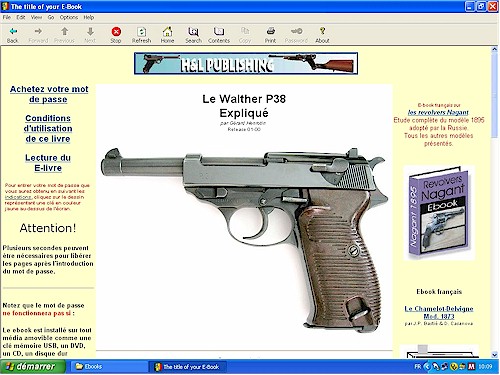
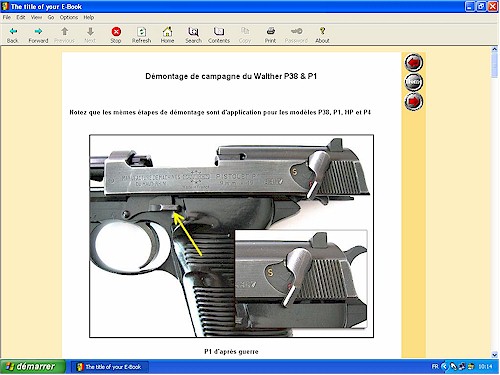
Démontage de campagne du Walther P38 & P1
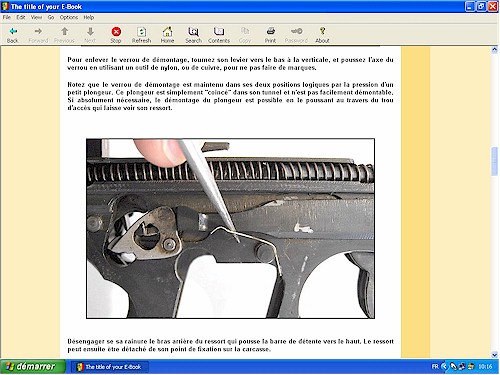
- Comment fonctionne le verrou de démontage
- Différence entre le P38 d'avant et d'après guerre (P-1)
Démontage avancé du canon et
de la glissière
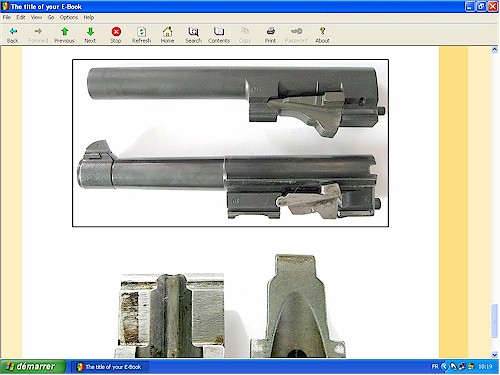
- Démontage des éléments du bloc canon
- Démontage des éléments de la glissière
Démontage avancé de la
carcasse ( I ) Démontage avancé de la
carcasse ( II )
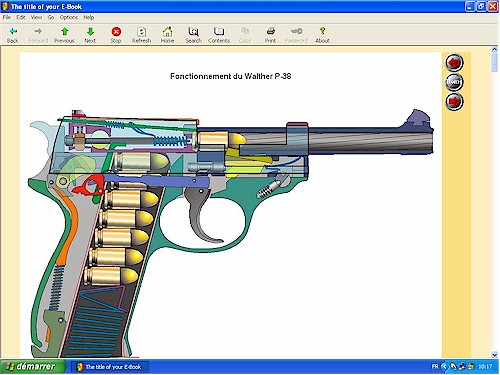
Fonctionnement du Walther P38
- L'indicateur de chargement
- Explication détaillée du système à double action
- Explication détaillée de la déconnexion
- Quand la cartouche n'explose pas
Verrouillage de la culasse du
Walther P38
Les sécurités du Walther P38
- La sûreté manuelle
- Désarmement du marteau
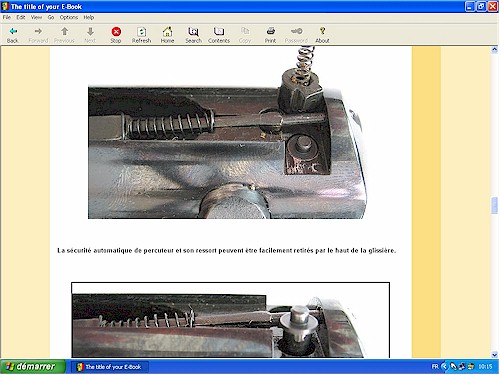
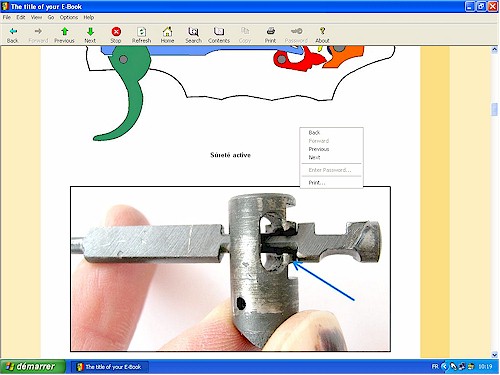
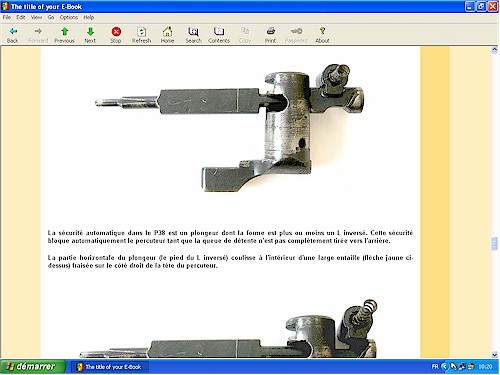
- La sécurité automatique
- Les sécurités d'avertissement
Un P38 expérimental examiné
à la loupe
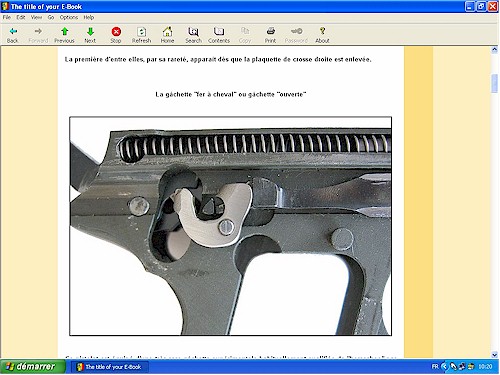
- La gâchette ouverte ou "fer à cheval"
- La détente expérimentale avec encoches
- Finition parkérisée ou phosphatée
Evolution technique du Walther P38
Le P38 d'après guerre (P-1)
- Démontage du Walther P-1
- Comparaison des pièces du P38 et du P-1 - Derniers changements dans le P-1
- Points de faiblesses du WaltherP-1
Les marquages du Walther P38
- Fonctionnement de la numérotation de
série
- Marquages d'épreuve, d'acceptation et de contrôle - Codes d'identification des producteurs
Le chargeur du Walther P38
- Démontage du chargeur du P38
- Marquages du chargeur du P38
- Utilisation de cartouches surpuissantes
The
Savage 1907 Pistol
This is our very first e-book and probably the very first to have been ever
issued in the firearm field. Download it for free and test it
on your PC. Discover what is possible today with the new technologies in this high
demanding field of firearm documentation. This e-book includes two
animated colored drawings of the internal workings of the gun. Jump into the future of the
technical documentation.
Reloading kit for pinfire
cartridges (7, 9 & 12mm) Revive your antique guns
Les Pistolets Colt - 100 ans de
production
This volume, published in 1998 is the second work relating to firearms written by
the Belgian author Gérard HENROTIN. As in his first title
issued in 1996 : "La Connaissance du Luger",
it includes a great variety of technical pictures, drawn from the infographic technology.
This ultra-modern process, used for the first time at this level in the firearms
literature, allows to reach one of the most difficult goal : the close understanding of
the firearms mechanical operation. All the illustrations of this site are stemming from
the same graphical craft present throughout the book. Our long chapter in this site,
relating to the Colt pistols will enlighten what kind of data you are supposed to find in
this beautifully illustrated book. Not only you will learn how these handguns function,
but you will get their complete historical background and various markings explanations. A
one of its kind book, that leaves the reader with a feeling of great satisfaction. In the
index below you will find some links to other pages with graphical illustrations. Book content and
how to order
La
Connaissance du Luger
This French book, published in 1996, is the first work of the Belgian author Gérard
HENROTIN relating to firearms. It is probably as well the first book using
at this level the infographical technologies in the firearms field. To fill that
challenge, many competences had to be gathered to offer a technically reliable content in
a modern and attractive form. These two objectives were reached to such an extend that the
volume became de facto the French reference on this famous German pistol.
This book was written to give a clear understanding of the pistol and its background, but
also to offer the demanding reader a true piece of art. You will find in our Luger
section, some illustrations drawn from the book, which includes some 600 color drawings
and 120 pictures. Book content and
how to order